
What spray foam insulation costs in Northwest Arkansas
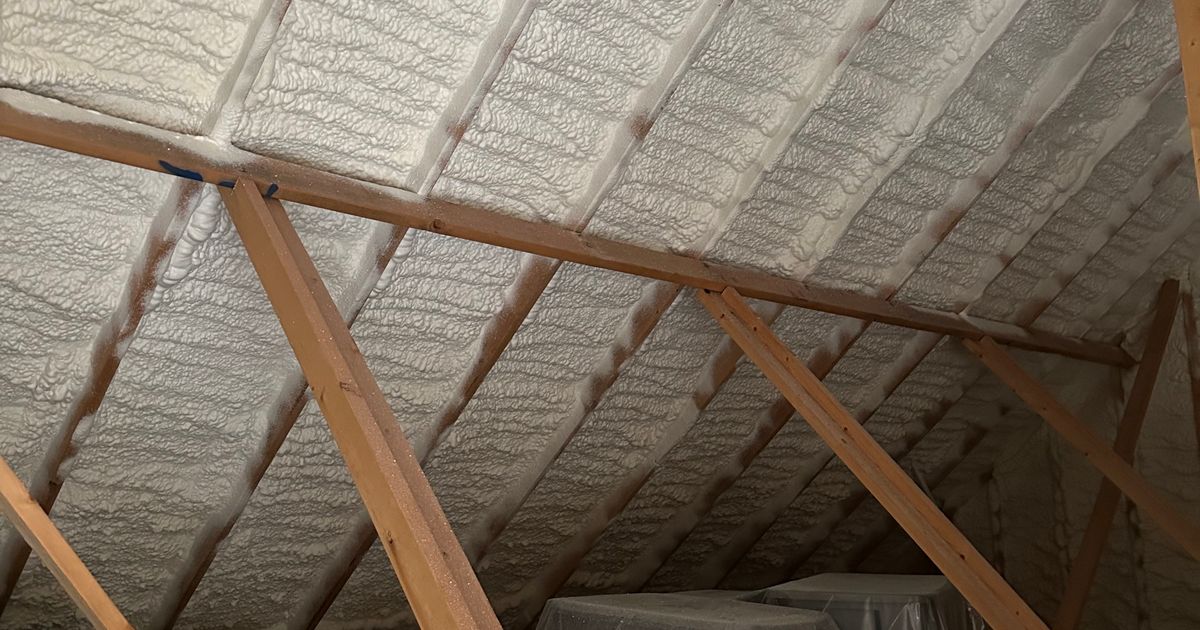
Nobody calls us to chat about R-values. The first question is almost always the price, and most insulation websites answer it with a form and a promise. Here is the honest version of the answer instead.
The three factors that set the price
Every spray foam quote in Northwest Arkansas comes down to three inputs.
The first is square footage, and more precisely board footage: the area being sprayed multiplied by the depth of foam it needs. An attic roofline and a rim joist band are very different quantities of material even in the same house.
The second is the foam itself. Open cell foam costs meaningfully less per board foot and is the right choice for most attics and interior walls here. Closed cell costs more because it is denser, delivers roughly R-6.5 per inch against open cell's R-3.7, and doubles as a moisture barrier, which is why crawl spaces, rim joists, and metal buildings usually call for it. A quote that does not say which foam it prices is not a quote you can compare.
The third is access. A walk-up attic with room to move costs less to spray than a hip roof with tight eaves, and an open new-construction wall costs less than anything retrofit. Labor follows difficulty.
What the numbers look like
We price every job in person and in writing rather than publishing a rate card, because the three factors above swing the total too far for a single number to be honest.
For calibration: one Fayetteville-area installer publishes a range of $1,700 to $4,200 per 1,000 square feet at three inches of foam, and that spread, more than double from bottom to top for the same area, is exactly the point. Which end of a range like that your project lands on depends on the foam type and the access, which is why we look at the actual house before putting a number on paper.
What we will commit to publicly: the estimate itself costs nothing, takes about an hour, and ends with a written price that does not move afterwards.
What a written quote should include
Whoever you get quotes from, including us, the paper should state five things: the areas being treated, the foam type for each area, the target depth in inches, whether removal of existing insulation is included, and the timeline.
If any of those is missing, the number on the quote is soft. The most common surprise in this trade is old insulation removal appearing as a change order halfway through a job; ours is priced up front or not needed, and the quote says which.
How to read a quote that looks too cheap
A spray foam quote well below the others usually means one of three things: thinner foam than the job needs, open cell where the location calls for closed cell, or a crew that is not carrying insurance. Thin foam is the expensive version of cheap, because you pay most of the price and miss most of the performance, and foam cannot be topped up as easily as blown-in fiberglass.
Ask any low bidder the same three questions: what depth, which foam, and can I see the certificate of insurance. A good outfit answers all three without friction.
When spray foam is the wrong spend
Part of an honest cost answer is that some houses should not buy spray foam at all. If your attic simply needs depth and your ductwork is sound, blown-in fiberglass delivers most of the comfort for a fraction of the price. If your problem is a damp crawl space, foam alone will not fix it and encapsulation is the real answer. We install all three, so the recommendation is not steered by what is on the truck.
That is also the fastest way to sanity-check any contractor: ask what they would do instead of foam. If the answer is nothing, you are hearing a product pitch, not an assessment.
Get the real number for your house
The free estimate takes four fields and thirty seconds, a real person calls back the same business day, and the visit ends with a written price built from your actual square footage, the right foam for each space, and honest access math. That is the only version of "what does it cost" worth acting on.