
Commercial insulation contractor serving Northwest Arkansas since 1996
WeatherGuard insulates warehouses, shops, offices, churches, and new commercial construction across Northwest Arkansas. We work from a written scope, to spec, on the schedule the job actually runs on, the same way this family has handled residential work since 1996.
What it fixes
- Energy costs bleeding through a large envelope
- Condensation inside metal structures
- Insulation specs that have to pass inspection on schedule
Who we work with
Commercial insulation calls reach us from four directions. General contractors who need an insulation sub that hits its dates and does not hold up the trades scheduled behind it. Building owners tired of watching a large envelope leak conditioned air in both directions. Property managers responsible for tenant comfort across a building or a portfolio. And churches, shops, and small operations where one person wears every hat and wants a straight answer about what the building actually needs.
We treat all of them the way we have treated homeowners since 1996. The building gets inspected before it gets quoted. The quote is written, itemized, and firm. And the crew that shows up belongs to the same family operation the estimate came from.
The buildings we insulate
Most of our commercial work in Northwest Arkansas falls into a handful of building types:
- Warehouses and distribution space, where the volume of air being conditioned makes the envelope the whole battle
- Shops and service bays, where doors open all day and the insulation has to make the most of the heat or cooling that stays inside
- Offices and retail suites, where comfort and sound both matter and the walls are framed
- Churches and community buildings, big open volumes that get conditioned hard a few days a week and sit idle the rest
- New commercial construction, where the envelope can be built right once instead of corrected after occupancy
If your building is metal skinned, the physics change enough that we keep a dedicated page for it: metal building insulation covers condensation control in detail.
Which system fits which building
There is no single commercial insulation product, and anyone who quotes one before walking the building is selling rather than assessing.
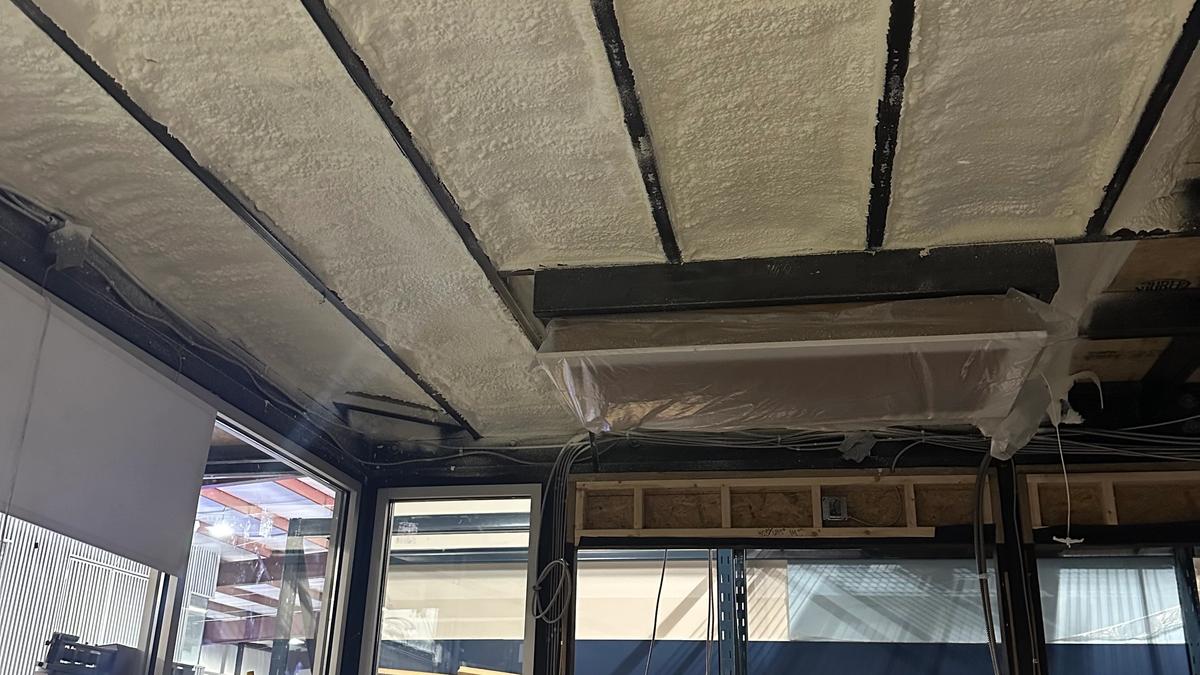
Closed cell spray foam is the workhorse for metal roof and wall panels. It air seals, acts as a vapor retarder, and adds rigidity to the panels it bonds to, which is exactly the combination a metal assembly needs to stop condensation. Open cell foam is the more cost-effective choice for interior framed walls and many rooflines, where the job is filling and sealing rather than moisture control.
BIBS, the blow-in blanket system, earns its place in framed commercial walls, especially between offices and tenant suites. The dense packed fill cuts sound transmission along with heat loss, and for office buildouts where a tenant can hear the meeting next door, it is usually the first thing we recommend.
The other recurring decision is where the thermal boundary belongs: at the roofline or at the ceiling deck. Sealing the roofline brings the whole volume inside the envelope, ductwork and all, which suits buildings that use their full height. Insulating at the ceiling deck conditions a smaller volume and can cost less to run. Which is right depends on where the mechanicals live, how the space is used, and what the spec says, and we walk the building before answering.
Working with general contractors
If you are a GC, the things you need from an insulation sub are not complicated, and they are the things subs most often fail at. Here is how we run commercial work.
Scheduling is a commitment, not an estimate. When we take a slot in your sequence, we show up in it. If weather or a supply issue threatens a date, you hear about it from us early, not from an empty jobsite.
The scope is written before the work starts: areas, systems, thicknesses, and what is excluded. When the spec calls for documentation, thicknesses and coverage get recorded so the work can be verified at inspection rather than argued about.
We carry insurance and provide the certificate without being chased for it.
And we work around other trades like professionals, because a spray crew that oversprays protected work or blocks an electrician's rough-in costs you more than it saves. Masking, containment, and coordination with whoever shares the building that week are part of the job, not extras.
Why a local family firm instead of a franchise
A national franchise sells you a brand and dispatches whoever is available. WeatherGuard is the same family that started insulating Northwest Arkansas buildings in 1996, working out of Bentonville, and the person who quotes your project answers for it afterwards. That matters on commercial work for a practical reason: buildings outlast crews, and when you call about a building we insulated years earlier, the company that did the work still exists, still answers the phone, and still stands behind it.
Local also means close. We are minutes from the commercial corridors of Bentonville and Rogers, and we work across the whole metro, so site visits and phased schedules are easy to accommodate.
How far we travel for commercial work
Commercial projects pull our crew further than residential ones. For commercial work the crew travels from Tulsa to Batesville and from north of Joplin down to Fort Smith.
Get a commercial scope in writing
Every commercial project starts the same way residential ones do: a walkthrough, then a written estimate with a firm scope, firm pricing, and a schedule you can build around. The free estimate is the fastest way to start, or call the shop and talk to a person. Plan sets and specs are welcome; send them over and we will quote to them.
Not sure what your house needs? One call, one honest answer.
Serving all of Northwest Arkansas
We take this work everywhere we install residential, from our Bentonville shop.
Also from WeatherGuard
- Spray Foam InsulationOpen and closed cell foam for attics, walls, metal buildings, and new construction. Seals air leaks and insulates in one pass.
- Blown-In FiberglassThe most cost-effective way to bring an under-insulated attic up to today's recommended R-value, usually in a single day.
- Crawl Space EncapsulationRemediation and encapsulation: vapor barrier, sealing, and conditioning that turn a damp crawl space into a dry, clean part of your home's envelope.
- BIBS Wall InsulationBlown fiberglass behind a fabric membrane for wall cavities. Denser than batts, better R-value, better sound control.
- Fiberglass Batt InsulationPrecut fiberglass panels for open walls, floors, and ceilings. A tried and true product that has been around for decades, sized right for the cavity.
- Metal Building InsulationClosed cell spray foam for shops, barns, and warehouses. Stops panel condensation, cuts summer heat, stiffens the structure.
Commercial Insulation questions
What homeowners ask before we start.
Do you handle commercial insulation projects in Northwest Arkansas?
Can you work around other trades on a commercial schedule?
How much does commercial insulation cost?
What kinds of commercial buildings do you insulate?
How far will you travel for a commercial project?
Planning a commercial project? Get a written bid from a local crew.
One call. One honest estimate. A family standing behind the work.